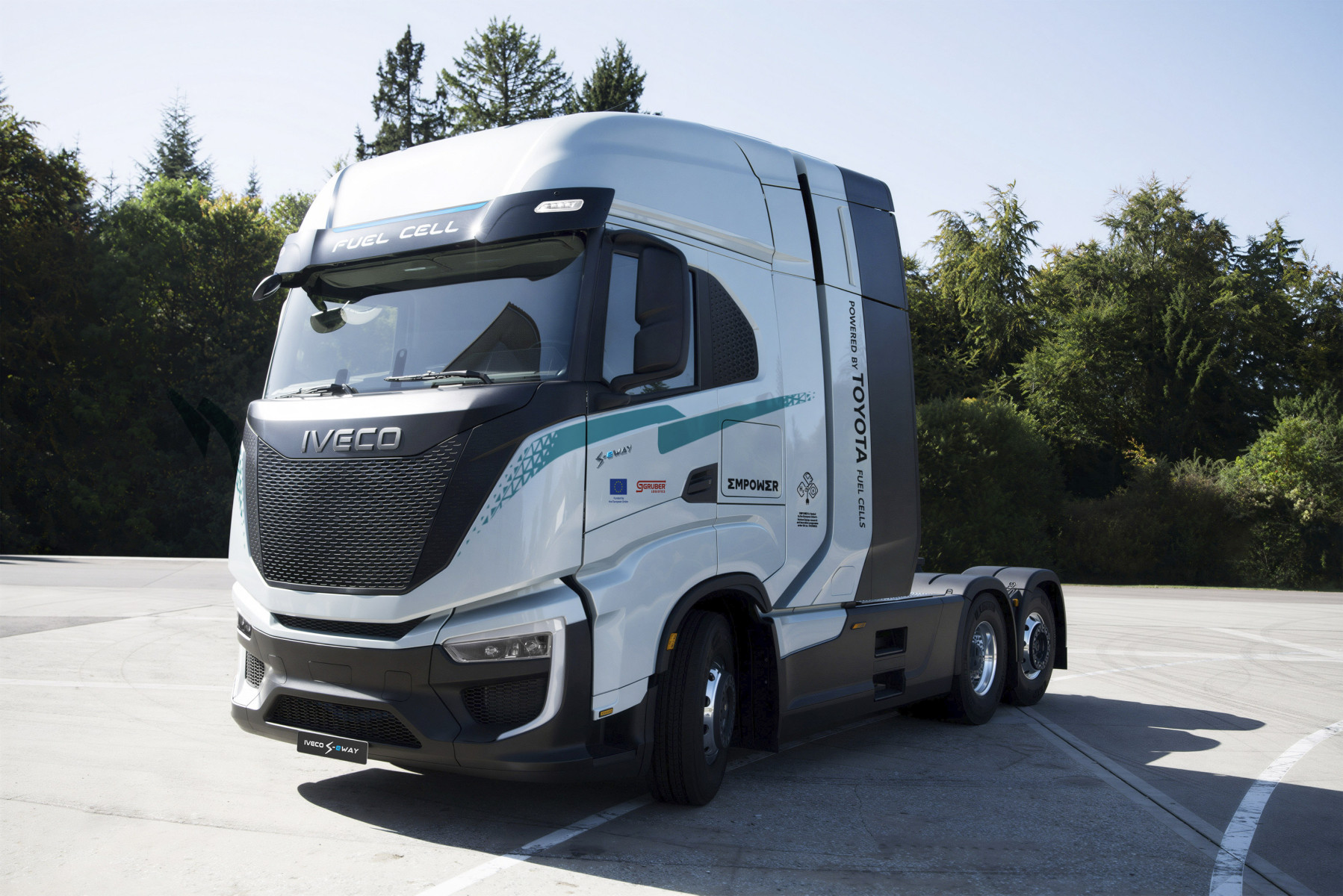
Toyota and IVECO join forces to advance next-generation hydrogen fuel cell heavy-duty trucks through the EU-funded EMPOWER project
- A strategic collaboration combining complementary capabilities to advance fuel cell technology for heavy-duty transport applications through the deployment and validation in customer operations
Higher power, improved energy efficiency and increased durability will advance hydrogen-powered transport toward commercial-scale deployment
BRUSSELS, Belgium / TURIN, Italy, 10 September 2026 – Toyota and IVECO announce a new collaboration under EMPOWER – the EU-funded Horizon Europe project dedicated to advancing zero-emission heavy-duty transport – marking a significant milestone in the development of next-generation fuel cell electric vehicles (FCEVs) for the heavy-duty transport sector.
Under the EMPOWER project, Toyota will provide the fuel cell system for IVECO's new-generation FCEVs. Leveraging the complementary strengths of the two companies, Toyota contributes its most advanced fuel cell technology, built on more than three decades of innovation, development and commercialization across mobility and industrial applications. IVECO leads the overall vehicle development, integration and validation activities, drawing on its pioneering role in sustainable transport and the experience gained through landmark hydrogen projects and real-world demonstrations.
The new FCEVs represent a major technological leap, delivering significant improvements across key performance indicators compared with IVECO's first-generation fuel cell trucks deployed as part of the H2Haul project. Building on the valuable operational insights gained through this programme, the new vehicle advances the maturity, efficiency and scalability of hydrogen-powered solutions.
Powered by Toyota fuel cell systems with a total output of 300 kW, the IVECO S-eWay Fuel Cell combines increased performance with improved efficiency, extending driving range beyond 900 km while significantly enhancing durability to more than 25,000 operating hours. In parallel, vehicle weight has been reduced, and the overall architecture has been simplified through a more efficient energy management strategy, requiring only half the battery capacity of the previous generation.
Together, these improvements bring fuel cell technology closer to the operational, economic and durability requirements of large-scale commercial transport. These advancements are aligned with the latest progress in Toyota fuel cell technology, which is increasingly focused on meeting the demanding requirements of commercial vehicle applications through higher reliability, improved efficiency and extended operational life.
Validation and testing activities are scheduled to begin in the fourth quarter of this year. The project aims to demonstrate the technology under demanding real-world operating conditions, with on-road trials planned to start in the first half of 2027. The insights gained from these activities will contribute to the development of commercially viable hydrogen-powered solutions for long-haul and heavy-duty transport applications, serving as a pilot platform for a future industrial scale-up.
Hydrogen is a key enabler of the future energy and mobility ecosystem. By joining forces with Toyota through EMPOWER, we are investing in a long-term vision for heavy-duty transport, one that combines sustainability, energy resilience and operational performance. Through EMPOWER, we are bringing together leading fuel cell expertise and advanced vehicle engineering to help unlock the full potential of hydrogen and drive the evolution of zero-emission heavy-duty transport. Together, we aim to accelerate the adoption of zero-emission solutions and contribute to redefining how goods move in the decades ahead.

The transition to zero-emission freight requires technologies that can meet the realities of commercial transport. For high-mileage, heavy-duty operations, hydrogen fuel cell technology offers strong potential by combining range, uptime and efficiency. By working together with IVECO, we aim to demonstrate how Toyota’s third-generation fuel cell system can help customers move towards zero-tailpipe emission logistics without compromising operational needs.
About IVECO
IVECO is a brand of Iveco Group designing, manufacturing and marketing a full range of light, medium and heavy commercial vehicles for a wide variety of applications.
Guided by its “Spirito in Movimento”, IVECO is evolving from a vehicle manufacturer into a true mobility partner, placing quality, customer experience and a human-centric approach to innovation at the core of everything it does. This vision is brought to life through three pillars: Motion by Design, expressing engineering excellence and distinctive Italian design; Motion through Experience, enabling a seamless and connected ecosystem of vehicles and services; and Motion as Family, reflecting IVECO’s commitment to staying close to customers, drivers and partners throughout their journey.
With a global network of over 2,300 service points, IVECO ensures consistent support, high service quality and uptime wherever its vehicles operate, standing by its customers and drivers at every step of their journey.
Rooted in its Italian heritage, IVECO combines engineering excellence with design, performance and attention to detail, shaping mobility solutions that are efficient, distinctive and built around people.
Toyota Motor Europe NV/SA (TME) oversees the wholesale sales and marketing of Toyota, GR (Gazoo Racing) and Lexus vehicles and parts and accessories, as well as Toyota’s European manufacturing and engineering operations. Toyota directly employs over 26,000 people and has invested over EUR 12 billion in Europe since 1990. Its eight European manufacturing plants are located in Portugal, the UK, France, Poland, Czech Republic and Turkey. Today, there are approximately 15,6 million Toyota and Lexus vehicles on European roads, whose drivers are supported by a network of 28 National Marketing and Sales Companies and around 2,300 retail sales outlets in 53 countries (EU, UK, EFTA countries , Israel, Turkey and other Eastern European countries). In 2025, TME sold 1,229,000 vehicles in Europe for a 7.2% market share. For more information, visit www.toyota-europe.com.
Toyota believes that when people are free to move, anything is possible. In the pursuit of "Mobility for All", Toyota aims to create safer, more connected, inclusive and sustainable mobility to achieve its mission of producing “Happiness for All”. In Europe, TME launched the KINTO mobility brand which offers a range of mobility services in 20 countries, and is growing its business-to-business sales of fuel cell products and engineering support. Contributing to the UN Sustainable Development Goals, Toyota is working to achieve carbon neutrality in its entire business across Europe by 2040.
Toyota views hydrogen as one of the key building blocks towards carbon neutrality, using fuel cell technology for mobility and in the wider economy beyond transport. Toyota’s advanced fuel cell technology is already integrated into passenger cars, buses, trucks, trains, marine and stationary applications for a range of business customers and other OEMs. To meet growing demand in the region, TME started producing its 2nd generation compact fuel cell modules in Europe in January 2022. In terms of infrastructure, Toyota's long-term vision is to establish 700bar as a standard for fuel cell electric vehicles and products.