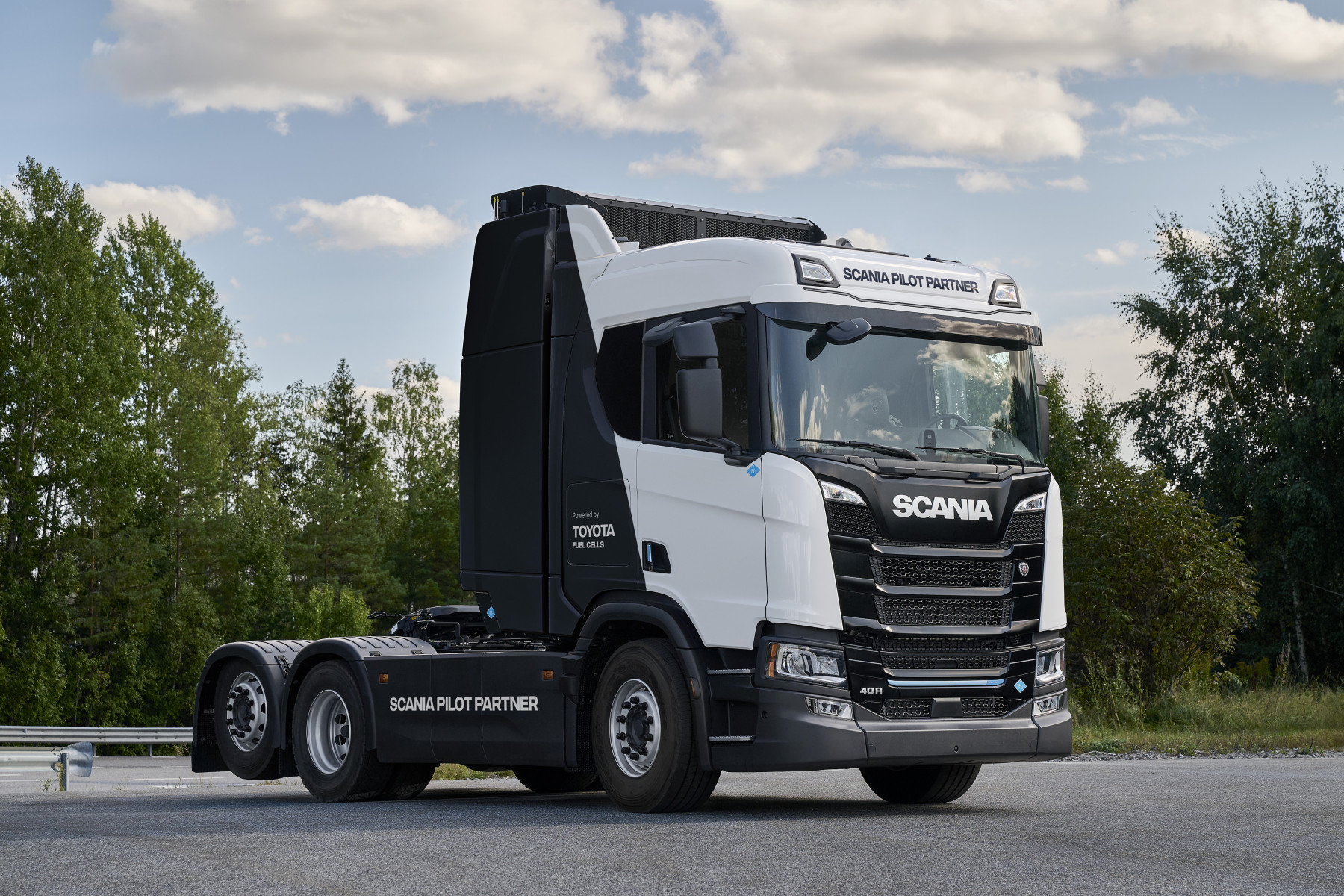
Toyota and Scania collaborate to test hydrogen fuel cell technology in heavy-duty transport
- Toyota and Scania announce a partnership to test hydrogen fuel cell solutions for heavy-duty transport.
- Toyota’s third-generation fuel cell systems will be integrated into 40 Scania heavy-duty vehicles within Scania’s Pilot Partner programme.
- The collaboration will provide real-world insights from operations to evaluate the potential of hydrogen fuel cell technology in selected heavy-duty applications.
SÖDERTÄLJE, Sweden / BRUSSELS, Belgium, 7 September 2026 - Toyota and Scania today announced a partnership to advance hydrogen fuel cell solutions for heavy-duty mobility through real-world logistics operations.
In this collaboration, Toyota will supply fuel cell systems for 40 heavy-duty vehicles within Scania’s Pilot Partner programme. The programme brings Scania together with selected customers to evaluate a wide range of sustainable transport technologies, including hydrogen fuel cell system, under real operating conditions. As zero-emissions heavy-duty fuel cell applications continue to expand, this initiative is expected to deliver confirmation of technical performance, operational efficiency and total cost of ownership. By integrating Toyota’s hydrogen fuel cell technology into this framework, the partnership will evaluate how fuel cell electric trucks can support demanding heavy-duty transport operations.
The vehicles will be equipped with Toyota’s latest third-generation fuel cell system, which delivers 300 kW of power in a highly compact design for heavy-duty applications and a wide range of other use cases.
The first Scania hydrogen fuel cell electric trucks will start operating during the first quarter of 2027.
We believe heavy-duty transport is key to building hydrogen demand and infrastructure. Furthermore, we believe hydrogen is the right solution for demanding heavy-duty applications, where long range, high utilisation and operational efficiency are essential. By bringing Toyota’s third-generation fuel cell system into Scania customers’ logistics operations, together we are taking an important step towards enabling hydrogen-powered mobility to play a larger role across Europe’s heavy-duty transport industry.

We are pleased to partner with Toyota to explore how fuel cell technology performs in demanding real-world transport operations. Through our Pilot Partner programme, we work with selected customers to test new technologies in actual use cases, learn from their experience and develop our solutions further. This collaboration will give us valuable insights into the opportunities and challenges associated with hydrogen fuel cell technology in heavy-duty transport.
Toyota will share more information at its IAA Transportation press conference on 14 September.
About Scania
Scania is a world-leading provider of premium transport solutions. Together with our partners and customers, we are driving the shift towards a sustainable transport system. Founded in Sweden in 1891, Scania now operates in more than 100 countries and employs around 53,000 people.
Scania Pilot Partner is a close collaboration with customers to test and evaluate new sustainable transport solutions in real operating environments. Each pilot project provides valuable insights into how the technology performs in daily customer operations, including operational efficiency and total cost of ownership across applications from city distribution to long-haul transport.
Toyota Motor Europe NV/SA (TME) oversees the wholesale sales and marketing of Toyota, GR (Gazoo Racing) and Lexus vehicles and parts and accessories, as well as Toyota’s European manufacturing and engineering operations. Toyota directly employs over 26,000 people and has invested over EUR 12 billion in Europe since 1990. Its eight European manufacturing plants are located in Portugal, the UK, France, Poland, Czech Republic and Turkey. Today, there are approximately 15,6 million Toyota and Lexus vehicles on European roads, whose drivers are supported by a network of 28 National Marketing and Sales Companies and around 2,300 retail sales outlets in 53 countries (EU, UK, EFTA countries , Israel, Turkey and other Eastern European countries). In 2025, TME sold 1,229,000 vehicles in Europe for a 7.2% market share. For more information, visit www.toyota-europe.com.
Toyota believes that when people are free to move, anything is possible. In the pursuit of "Mobility for All", Toyota aims to create safer, more connected, inclusive and sustainable mobility to achieve its mission of producing “Happiness for All”. In Europe, TME launched the KINTO mobility brand which offers a range of mobility services in 20 countries, and is growing its business-to-business sales of fuel cell products and engineering support. Contributing to the UN Sustainable Development Goals, Toyota is working to achieve carbon neutrality in its entire business across Europe by 2040.
Toyota views hydrogen as one of the key building blocks towards carbon neutrality, using fuel cell technology for mobility and in the wider economy beyond transport. Toyota’s advanced fuel cell technology is already integrated into passenger cars, buses, trucks, trains, marine and stationary applications for a range of business customers and other OEMs. To meet growing demand in the region, TME started producing its 2nd generation compact fuel cell modules in Europe in January 2022. In terms of infrastructure, Toyota's long-term vision is to establish 700bar as a standard for fuel cell electric vehicles and products.